
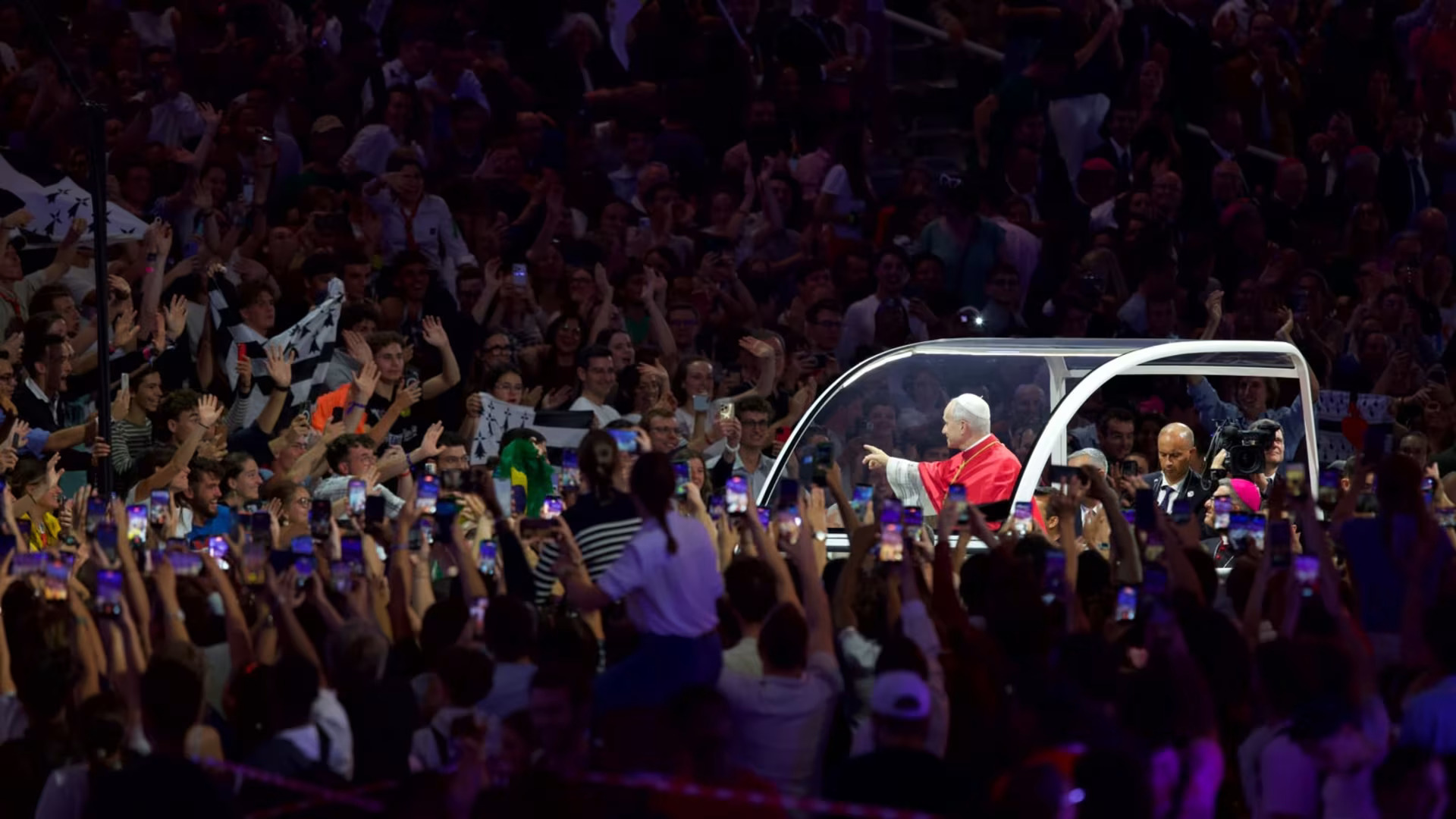
SAINT-DENIS, France — At least 80,000 young Catholics flocked to France’s national soccer stadium north of Paris on Friday night to pray with Pope Leo XIV and to hear his message for the Church.
Whether they were lifting their arms in praise-and-worship or silently venerating the relics of saints and the Holy Tunic of Christ, the entire Stade de France was united in prayer before Leo’s arrival and throughout an hour and a half-long program.
People from working-class suburbs stood alongside families from the more traditional Catholic milieu associated with the city of Versailles. In the lines outside the stadium, Breton and Vendéan flags — from regions with strong Catholic histories — stood alongside groups with a more popular, charismatic style.
One young woman, 29-year-old Romance Bono, wiped tears from her eyes as the pope entered the stadium to deafening cheers.
“It brought tears to my eyes because it’s such an emotional moment,” she told EWTN News. “Seeing all these young people cheering for the pope like a rock star, that is the strength of the Church, and it is the future of the Church here. It was very moving.”

Young people greet Pope Leo XIV at a prayer vigil at Stade de France on Sept. 25, 2026 in Saint-Denis, France. | Credit: Vatican Media
Soon after Pope Leoʼs arrival at the stadium, hundreds of young French Catholics staged an artistic performance depicting French saints and the history of the Church in France, including the use of live horses, and culminating in fireworks launched above the stadium.
One 28-year-old volunteer, Jacques-Henri de Livron, told EWTN News that as soon as he heard the pope was coming to France, he decided to take a day off work to see him. He was so afraid of missing the events that he volunteered to make sure he could be in attendance. De Livron grew up in a Catholic environment, but returned to the faith in his twenties after painful deaths among his siblings and close friends. Those experiences, he said, made him recognise its value anew.
“Christianity is really the religion of the human person,” he said. “In this age of narcissism, it helps us get out of ourselves, turn toward others and care about them instead of thinking only about ourselves. People often call it a religion of the book, or a religion of revelation. But it’s much more than that. It’s the religion of the human person.”
De Livron also made a point of sharing his surname, which is unusual in France, where anticlerical culture is widespread and religious people usually ask to be identified in press reports only by their first names in order to avoid trouble at work. “I want to be part of a generation that stops being afraid to testify, that gives its name, and isn’t afraid of anything,” he said.
Pierre-Alain Belaube, 34, described the effort to arrive hours early after a long day at work, and to fight the crowds to enter into the packed stadium, as “200% worth it. It’s a privilege to be here.”
Belaube described himself as a formerly lukewarm Catholic, whose life was transformed when he read the autobiography of St. Ignatius of Loyola.
“I have the hope that many more young people will open their hearts to God and let him change their life,” he said. “I think that such an event can be, for many, the first milestone of a life-changing experience. I hope we will inspire many more young people to get to know Jesus.”
Thibault, a religious brother who preferred not to give his last name because he did not have permission from his superiors to speak with reporters, accompanied 400 members from the youth movement of his religious community, the Missionaries of Divine Mercy, to the event.
He told EWTN News that it is very moving to be surrounded by young people “wanting to say, ‘Here I am, I’m Catholic and I’m proud to show it.’”
The young religious, who is also studying for the priesthood, said he hopes Leo’s visit to France “will contribute to the missionary awakening that needs to happen in France.”
While the primarily secular country is seeing a surprising surge in baptisms, he said he thinks “Catholics still find it difficult to go out and meet people, to be missionaries in their daily lives.”
“I think this could become a significant moment in the life of the Church in France.”
In his message during the prayer, which included religious hymns and a Litany of Saints, Leo invited young people to shun evil and strive for good.
“God is the Lord of history, and no matter what happens, he guides its course toward salvation. In Christ, every evil comes to an end, precisely because that end becomes the beginning of a new and eternal life,” he said.
“The work well done, the work that is good, is the redemption that Jesus accomplishes for us,” Leo said. “Through his struggle against sin and death, Christ’s victory sets us free. He saves us from all evil and invites us to all that is good.”
The pontiff also answered the questions of two young French people as part of the evening’s program.
Chloé, 25, talked about her involvement in her parish and in a group of young Catholics “eager to live out and share their faith with others.” But she lamented that society “is founded on different principles” and sometimes has “no regard for the question of God.”
Pope Leo responded that, “It is true, as you say, that the society in which we live seems indifferent to God. But the Lord is not indifferent to us! This is what matters, and what always gives us hope.”
Chloé, who is from Saint-Denis, described the vitality of Catholic life there. Saint-Denis is often described as a quartier sensible (“a vulnerable neighbourhood”). Her testimony echoed what EWTN News heard from local Catholics in the crowd, including people from immigrant backgrounds, about the life of the Church in their neighbourhoods that have a strong Muslim presence.
A young man from Burgundy, named François, also addressed the pope and asked him how young people can discern how the Lord is calling them to serve.
Leo’s advice to young people was to keep their hearts open to the suffering of their peers, to follow Jesus, and to draw inspiration from the examples of the saints.
“Even in the face of persecution, these brothers and sisters of ours opened paths of peace. Look to those priests who were passionate about Christ, such as St. Eugene de Mazenod and St. John Mary Vianney. Look to the mystical beauty of St. Thérèse of the Child Jesus; the fervour in charity and mission of Blessed Pauline Jaricot; and the courage of the 50 martyrs of the apostolate who served their brothers and sisters even to the point of sacrificing their own lives during the Second World War,” he said.
“These saints changed the course of history by leading many people from hardship to hope, since they first changed their own hearts, transforming them in the light of faith.”
The youth vigil was the pope’s last event on a packed first day in France. The Sept. 25-28 journey will also take him to Lourdes and Metz.
Source: EWTN News