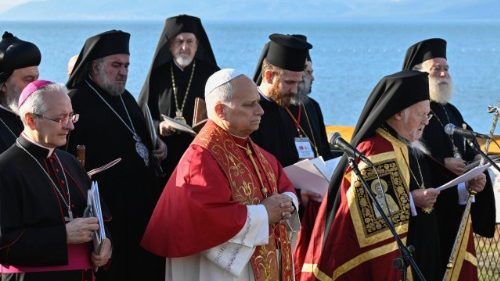
At the site of ancient Nicaea, Pope Leo XIV joined around 27 other leaders of Christian Churches to commemorate the 1,700th anniversary of the First Ecumenical Council in the Church’s history.
The ecumenical prayer service took place on the second day of the Pope’s Apostolic Journey to Türkiye.
In his address, the Pope thanked Patriarch Bartholomew I, Ecumenical Patriarch of Constantinople, for his “great wisdom and foresight” in calling for Church leaders to celebrate this important anniversary together.
He also expressed appreciation to the Heads of Churches and Representatives of Christian World Communions for attending the event.
Pope Leo recalled that the Council of Nicaea was held in 325, saying it invites all Christians, even today, to ask ourselves who Jesus Christ is for us personally.
“This question is especially important for Christians,” he said, “who risk reducing Jesus Christ to a kind of charismatic leader or superman, a misrepresentation that ultimately leads to sadness and confusion.”
The Council was held to respond to the Alexandrian priest Arius’ claim that Jesus was only an intermediary between God and humanity, saying He was not fully divine and ignoring the reality of the Incarnation.
“But if God did not become man, how can mortal creatures participate in His immortal life?” asked Pope Leo. “What was at stake at Nicaea, and is at stake today, is our faith in the God who, in Jesus Christ, became like us to make us ‘partakers of the divine nature’.”
The Council of Nicaea, he said, agreed upon the Christological confession we now call the Nicene Creed, which is professed by all Christian Churches and Communities.
The Symbol of Faith, as it is known, was of “fundamental importance in the journey that Christians are making towards full communion.”
“Faith ‘in one Lord Jesus Christ, the Only Begotten Son of God, born of the Father before all ages… consubstantial with the Father’ (Nicene Creed),” he said, “is a profound bond already uniting all Christians.”
Rt. Revd. Anthony Poggo, Secretary General of the Anglican Communion
He upheld the role of religions in serving truth and encouraging individuals to seek dialogue and respect.
“We must strongly reject the use of religion for justifying war, violence, or any form of fundamentalism or fanaticism,” the Pope said. “Instead, the paths to follow are those of fraternal encounter, dialogue and cooperation.”
Finally, Pope Leo prayed that God the Father may help the commemoration of the 1,700th anniversary of the Council of Nicaea bear “the abundant fruits of reconciliation, unity and peace.”
As the prayer service concluded, the leaders of Christian Churches and Communions prayed the Nicene-Constantinopolitan Creed together, omitting the Filioque.
Iznik, Türkiye, Ecumenical Prayer Meeting
Source: Vatican News