
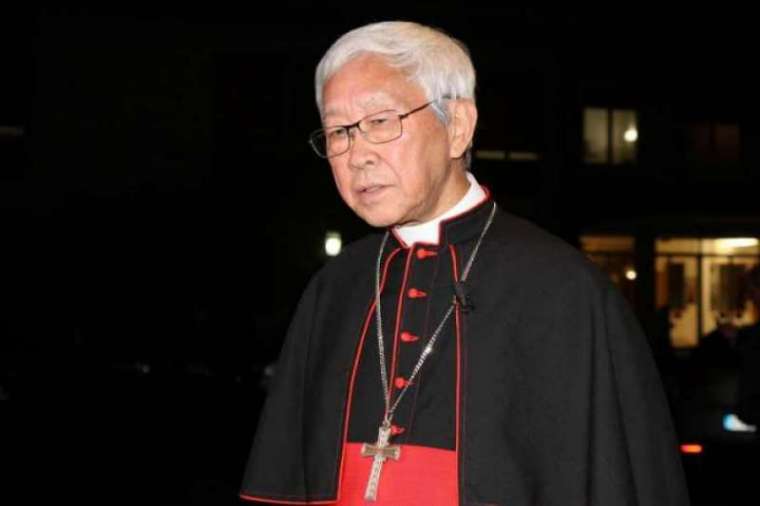
The newly-appointed Dean of the College of Cardinals purportedly sent a letter to cardinals Wednesday claiming that the China-Vatican deal deal represents the minds of St. John Paul II and of Benedict XVI, and that Cardinal Zen is mistaken in his opposition to the deal.
An Italian text of the letter from Cardinal Giovanni Battista Re, dated 26 February, was published on Saturday 29 February by La Nuova Bussola Quotidiana.
“I desire first of all to emphasize that, in their approach to the situation of the Catholic Church in China, there is a profound symphony of the thought and of the action of the last three Pontificates, which — out of respect for the truth — have favored dialogue between the two parties and not contrariety,” Cardinal Re wrote.
“Cardinal Zen has affirmed several times that it would be better to have no Accord than than a ‘bad Accord’. The three last Popes did not share this position and supported and accompanied the drafting of the Accord that, at the present moment, seemed to be the only one possible,” he stated.
Cardinal Joseph Zen Ze-kiun, Bishop Emeritus of Hong Kong, has been an outspoken opponent of the 2018 agreement between the Vatican and the People’s Republic of China regarding episcopal appointments.
The Church in mainland China has been divided for some 60 years between the underground Church, which is persecuted and whose episcopal appointments are frequently not acknowledged by Chinese authorities, and the Chinese Patriotic Catholic Association, a government-sanctioned organization.
The agreement between the Holy See and Beijing was intended to normalize the situation of China’s Catholics and unify the underground Church and the CPCA.
Cardinal Re, who was confirmed as Dean of the College of Cardinals just six weeks ago, wrote to the cardinals that “with reference to the various public interventions” of Cardinal Zen, “I feel obliged to share some considerations and to offer some elements which favor a serene evaluation of the complex questions regarding the Church in China.”
For Cardinal Re, while St. John Paul II “on the one hand favored the return to full communion of the bishops consecrated illicitly in the course of the years beginning in 1958, and at the same time it was his desire to sustain the life of ‘clandestine’ communities which were led by ‘unofficial’ bishops and priests, on the other he promoted the idea of reaching a formal Accord with the governing Authorities on the nomination of bishops.”
That accord was eventually reached, he said, and signed in Beijing Sept. 22, 2018.
It is particularly surprising to the dean of cardinals that Zen has written that, “the accord signed is the same one which Pope Benedict had, at the time, refused to sign”.
“That assertion does not correspond to truth,” Cardinal Re stated.
“After having personally taken note of the existing documents in the Current Archive of the Secretariat of State, I am able to assure Your Eminence that Pope Benedict XVI had approved the draft of the Accord on the nomination of Bishops in China, which only in 2018 was it possible to sign.”
Cardinal Re was an official of the state secretariat from 1989 to 2000.
Because the deal provide for the pope’s intervention in bishop appointments in China, the dean said, “the expression ‘independent Church’ can no longer be interpreted in an absolute manner, as ‘separation’ from the Pope, as was the case in the past.”
“Unfortunately, there is slowness in drawing in loco all the consequences which derive from this epochal change both on the doctrinal and on the practical level and there persist dolorous tensions and situations,” Cardinal Re said.
“It is unthinkable, on the other hand, that a partial Accord — the Accord touching, in fact, only the theme of the nomination of Bishops — changes things in almost an automatic and immediate way in the other aspects of the life of the Church.”
Cardinal Re objected to Cardinal Zen’s evaluation of the pope’s pastoral guidelines concerning the civil registration of clergy in China, saying that these guidelines “were designed precisely to safeguard the faith” in complicated and difficult situations.
Those guidelines recognize the choice of those who feel that they cannot in good conscience register with the government and accept sinicization. However, reports indicate that those who decline to register are facing harassment and persecution.
Cardinal Zen’s intervention, Cardinal Re said, “helps us to comprehend how difficult still is the path of the Church in China and how complex is the mission of pastors and of the Holy Father!”
“We are, therefore, all called to unite ourselves closely to him and to pray intensely for the Holy Spirit to support him and to support the communities of the Catholic Church in China, who despite suffering for a long time demonstrate their loyalty to the Lord, on the path of reconciliation, of unity and of mission at the service of the Gospel.”
The Vatican-China deal has been roundly criticized not only by Cardinal Zen, but also by human rights groups and religious freedom advocates in the US, and the Holy See has taken pains to defend and promote it.
Fewer than two weeks before Cardinal Re’s letter was sent, the Holy See publicized a meeting held between its Secretary for Relations with States and the Chinese foreign minister, during which the accord on episcopal appointments was discussed.
In March 2019, Cardinal Fernando Filoni, then-prefect of the Congregation for the Evangelization of Peoples, said that the accord “will be a very good thing for the Church,” and he criticized those who “run the risk of rowing out of sync within the barque of Peter.”
And one year ago, Vatican Secretary of State Cardinal Pietro Parolin — who Cardinal Zen holds to bear primary responsibility for the deal — said at a conference that the agreement must be implemented.
Cardinal Zen told CNA Feb. 11 that “the situation is very bad” in China, and added that “the bad things come from [Parolin].”
According to Cardinal Zen, Cardinal Parolin is “so optimistic about the so-called ‘Ostpolitik’, the compromise.”
But, Cardinal Zen told CNA, “you cannot compromise” with the Chinese Communist Party, whom he called “persecutors” of the faith.
“They want complete surrender. That’s communism.”
“More and more, the Church [is] under persecution,” Cardinal Zen said, “both the official Church, and the underground.”
Source: CNA