
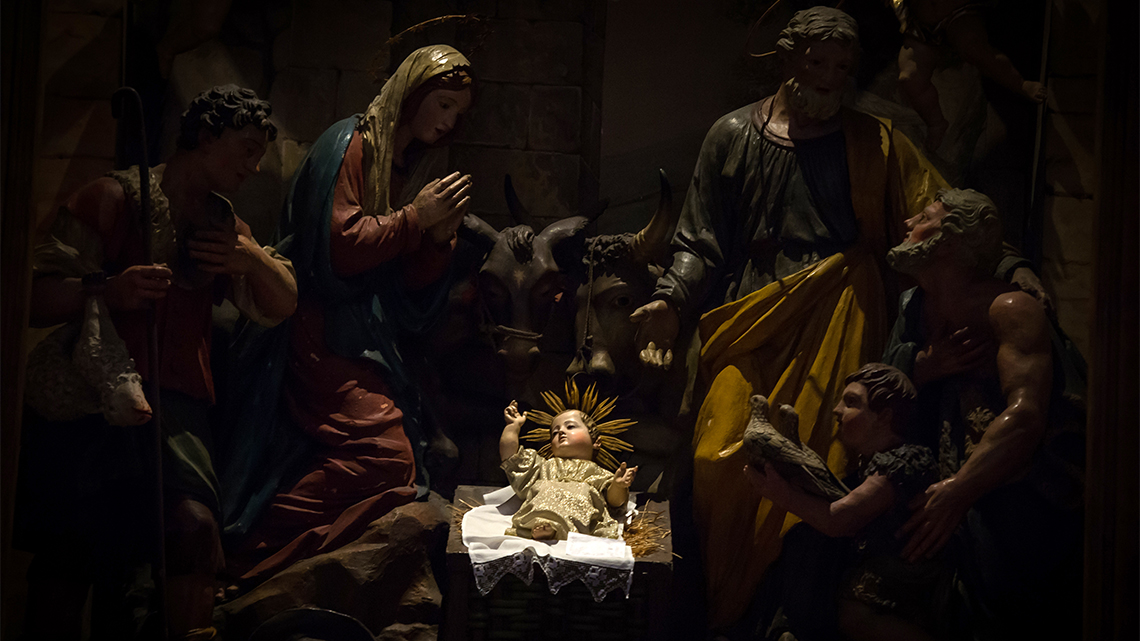
Image Source | CBCEW
Archbishop Bernard Longley and Bishop Richard Moth have released a statement affirming what the coming of Christ at Christmas means to Catholics, expressing their shared concern at societal tensions and division in our communities, something that does not “reflect the spirit or message of Christmas.”
The Chair of the Department for Dialogue and Unity, and Chair of the Department for Social Justice of the Bishops’ Conference respectively, Archbishop Longley and Bishop Moth describe our participation in Advent and the celebration of Christmas as “our lived response in opposition to those who seek division.”
The statement presents hope, joy, peace, and love as the incarnational antidote to these divisions.
Statement
Today, 17 December, sees the beginning of the octave before Christmas, an ancient part of our liturgy, dating back to the fourth century, with a focus upon the coming of Christ the Prince of Peace at Christmas and marked by the singing of the ‘O Antiphons’ at the evening Office of Vespers.
The Christmas story gives us inspiration and hope in a world that can feel divided. We are concerned about the tensions that are growing in society and the desire by some groups to sow seeds of division within our communities. This does not reflect the spirit or message of Christmas.
From the Latin word adventus, meaning “coming” or “arrival,” referring to Jesus’ birth and second coming, Advent is a time of preparation. Parishes will have an Advent wreath with candles which are lit each Sunday as we approach Christmas. The candles symbolise hope, peace, joy and love. For Catholics these form the focus of our liturgy, prayer and social action. Our participation in Advent and the celebration of Christmas is our lived response in opposition to those who seek division.
Hope
There was ‘no room at the inn’ for the Saviour of the world. We recognise that many people feel marginalised, unheard and overlooked. The incarnation demonstrates God’s love for all. Our parishes across the country will be filled with people from all backgrounds, ages and ethnicities. We all have a home in the Church and, in a sense, in the Holy Family of Mary, Joseph and Jesus. As St Paul says in his letter to the Philippians (3:20) “We are all citizens of Heaven.” Our parishes should be a beautiful demonstration of our unity and a sign of hope that faith brings people together from all walks of life.
The Christmas story provides ample examples of how the message should be spread without limit to all who have an open heart as St Paul’s Letter to the Romans (2:11-13) states “God does not have any favourites!” The angels appeared to the shepherds, the poorest of the poor.
The Magi travelled from a far-off land, called to meet the Messiah who was the Saviour of all. The Holy Family had to travel to Egypt as refugees. We should empathise with all who come to this country for their safety.
Joy
This year has been a Jubilee Year of Hope in our community, a time for pilgrimage and prayer. A time to re-establish a proper relationship with God, with one another, and with all creation. The Jubilee Year is a joyful connection which unites Catholics all across the globe in a common celebration. As we reflect on the year we remember the Canonisation of London-born St Carlo Acutis, the Catholic Church’s first Millennial saint, and the joy that our children and young people in our Catholic schools and parishes bring to the mission of the Church.
Peace
We have a duty as Christians to be bridgebuilders and peacemakers. Pope Francis in his letter, Fratelli tutti, called for us to build a society at peace with itself and where people are at peace with each other. Doing so, he said it required “a spirit of openness to everyone”.
We have seen increased hostility towards religious communities in this country. However, in this 60th Anniversary year of the Declaration of the Second Vatican Council’s Nostra Aetate, we renew our gratitude for our fellowship with other faith communities, especially at this special time for Christians. Reflecting on this anniversary, Pope Leo said “we cannot truly call on God, the Father of all, if we refuse to treat in a brotherly or sisterly way any man or woman created in the image of God.” (Pope Leo XIV at “Walking Together in Hope,” a celebration of 60 years of Nostra Aetate, 18/10/25). We are committed to dialogue and we continue to pray for peace between our different faiths in our own communities and abroad, on the basis of our shared desire across the different faith communities to work for peace in the world.
Love
As Catholics our preparation for Jesus’ arrival is carried out through prayer and through charitable action. “Our faith is seen in our good works” reflects the Catholic understanding, rooted in the Bible, especially James 2:24. Through the charitable work of the Church we bring love, material support and fraternity to those in particular need. As Pope Benedict wrote, charity is an indispensable part of the very being of the Church. Our communities will be donating to foodbanks, giving generously to charities, visiting the lonely and our churches provide places for peace, prayer and reflection. Just as the shepherds and magi were welcomed into the stable, so should our parishes be places of sanctuary and welcome for all. We recognise the millions of Catholics across the country who are living out their faith in their local communities in a way which unites us in serving the common good. As Pope Benedict said, “love of neighbour is a path that leads to the encounter with God.” (Deus Caritas Est 16) This is at the heart of what it is to be a Catholic at Christmas.
O Sapientia, quae ex ore Altissimi prodiisti, attingens a fine usque ad finem, fortiter suaviterque disponens omnia: veni ad docendum nos viam prudentiae.
O wisdom, you come forth from the mouth of the most high. You fill the universe and hold all things together in a strong yet gentle manner. O come to teach us the way of truth.
Source: CBCEW